
Skip to content
Join the movement: follow us Follow on Instagram
Emanet Dünya logoEmanet Dünya TR

All articles

Every article we have published, newest first. Each one has its source beside it.

Easy read
  • This page has all our articles.
  • The newest article is at the top.
  • Each article shows its source.

November 2026

24 November · Remembrance

In the footsteps of our Chief Teacher

On 24 November 1928, Atatürk accepted the title of Chief Teacher of the Nation Schools, the schools opened to teach adults the new Turkish alphabet. As we remember him today, we also want to say which line of thought Emanet Dünya was founded in the footsteps of.

Read the full articleClose the article
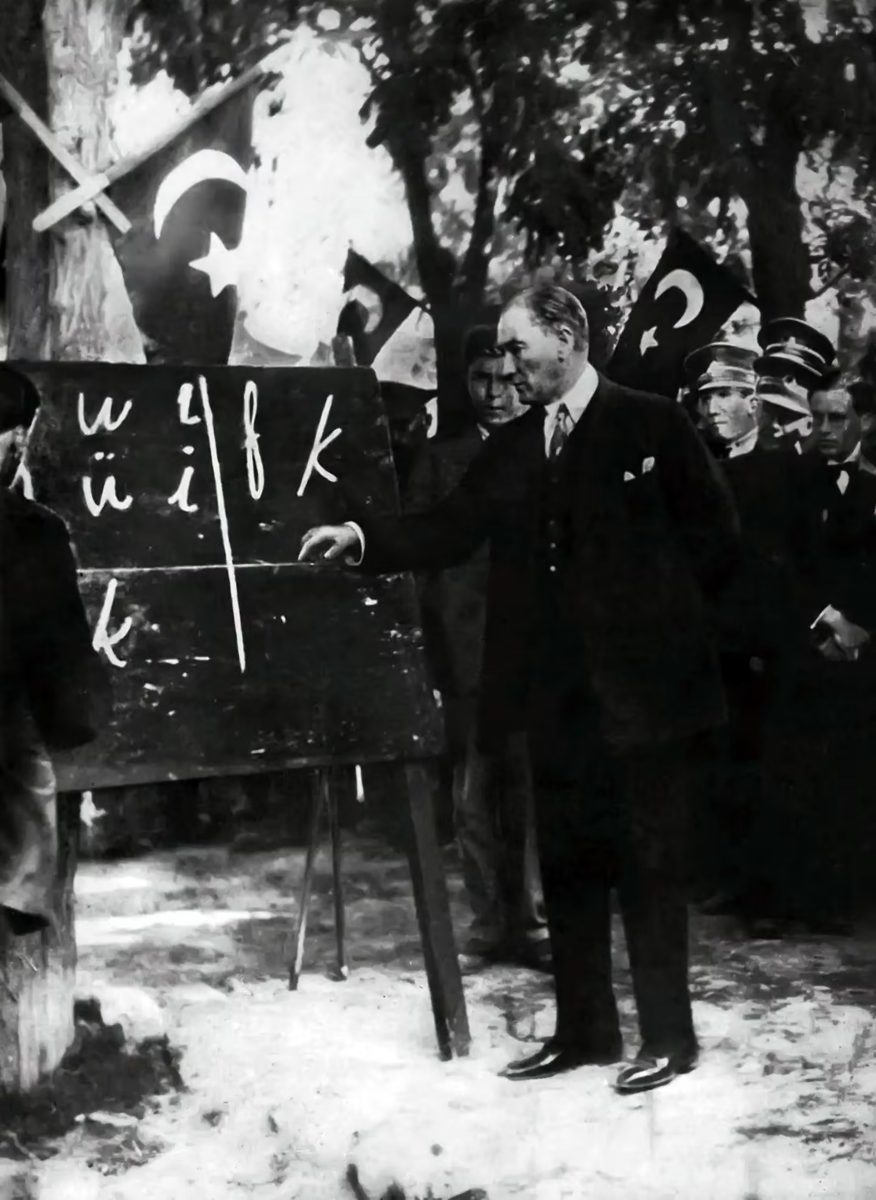
Black-and-white archive photograph: Atatürk stands outdoors under trees beside a blackboard framed by flags and shows the new Turkish letters; students and officers stand behind him.
Atatürk, 1928: teaching the new letters at a blackboard. Archive photograph.

“Teachers! The new generation will be your work.” — Gazi Mustafa Kemal Atatürk

Some words outlast the time in which they were spoken. These are among them. A child’s tomorrow and a society’s future are shaped by the people who grow up today and the ideas that are nurtured today. When Atatürk said this to teachers, he was speaking not only to a profession but also to his trust in people and in the future.

A blackboard

In the summer of 1928, on 9 August, Atatürk introduced the new letters to the public at Sarayburnu in Istanbul. Then he travelled from town to town, stood at the blackboard himself, and gave his first lesson in Tekirdağ. The new alphabet became law on 1 November. On 11 November the Council of Ministers gave him the title of Chief Teacher of the Nation Schools; the title became official on 24 November, when the Nation Schools Regulation was published. Teachers’ Day has been celebrated in Türkiye on this date since 1981.

A president stood with a piece of chalk, explaining a letter. He showed that neither age, nor rank, nor distance stood in the way of learning. By teaching one letter he opened a door, and behind it were books, ideas and new possibilities. A true teacher is not only someone who shares what they know, but someone who opens a path so that others can learn too.

Knowledge is for understanding life

“For everything in the world, for civilization, for life, for success, the truest guide is science.” These words remind us that knowledge gains meaning when it does not stay in a book but mixes into life. (Our translation.)

At Emanet Dünya we also begin with a question: Where does this water come from? How did this bread reach our table? What was this object made from? Knowing a tree not only by its trunk but also by its roots, and knowing a product not only by its price but also by the work and the source behind it, lets us look at our relationship with the world from another place. This is why every piece of information has a Source button beside it, and why we do not share information whose source is unclear. In the Glossary we explain words in everyday language; with the Claim Detective we test the source of a claim together.

Land without trees

In 1925 Atatürk laid the foundation of what is now the Atatürk Forest Farm on a treeless, barren stretch of land near Ankara. It is told that he said: “Plant this place so thoroughly that even a blind person would notice they are among greenery.” The story that his pavilion in Yalova was moved 4.80 metres on rails so that a branch of the plane tree beside it would not be cut is told as an example of the same care. On 11 June 1937 he gave his farms, with all their facilities, to the Treasury as a gift.

We tell these two stories on the Our roots › Nature and trees page too. We thought about the same thing when we chose our name: “Emanet” in Turkish means something entrusted to you to look after. It is not only an object left with us. The shade of a tree, a recipe a mother taught, the knowledge a craftsperson gathered over years, an environment where a child can grow up safely: these are entrusted to us too. Living without treating any of them as only our own is one of the deepest meanings of sustainability.

A child’s question

Atatürk’s trust in children and young people was part of his trust in the future. A small question from a child can sometimes bring into view what an adult has not noticed for years. Where does a drop of water come from? What does it take for bread to reach our table? Could something we no longer use have another life?

In our Children section we want children to discover the world rather than memorise it. In the Youth section, as we write in our Manifesto, we leave the floor to young people: “Young people lead the conversation.”

We follow a path too

Atatürk linked a nation’s future to education, science, reason and the people who grow up in it. We want to walk along the path of thought he opened, with the questions of another age: a time when resources are shrinking, ways of living are changing, and the relationship between people and nature, and between people themselves, is being thought through again.

We do not do this by lecturing. In the Water Detective we follow the path of a drop of water together, in What Happens to This? the second life of an object, and in the Carbon footprint tool the trace of our everyday choices. As we write in our Manifesto, we do not frighten, we do not preach, we do not blame; we speak plainly and accurately. We are not the voice of any institution, party or brand. We write this article not on behalf of an organisation but as people who are grateful to their teachers.

The mark a teacher leaves

A teacher’s work sometimes grows in places the teacher will never see. A word said years ago changes a person’s decision; a small piece of knowledge taught to a child becomes, years later, the protection of a tree; a question that comes to a young person’s mind becomes a lifetime of research. One idea passes from one person to another, and one curiosity gives birth to another. Raising a person leaves a mark not only on that person’s life but on the lives they will touch.

Perhaps the most valuable thing we can entrust to the future is people who try to understand the world, who care about life, and who never give up taking responsibility for a better tomorrow.

We remember our Chief Teacher, Gazi Mustafa Kemal Atatürk, with respect and gratitude. To all the teachers who touched our lives, grew our thinking and fed our curiosity: thank you for being there. Thank you for teaching. Thank you for believing in the future.

Happy Teachers’ Day, 24 November.

Emanet Dünya

Our roots: Nature and trees → Manifesto →

Source
Republic of Türkiye Ministry of National Education, 24 November Teachers’ Day message (2024); TRT Haber, “Why does Türkiye celebrate Teachers’ Day on 24 November?”; Atatürk’s Speeches and Statements, vol. II; TÜBİTAK Bilim Çocuk, Atatürk Forest Farm; Journal of the Union of Turkish Bar Associations, “The Legal Status of the Atatürk Forest Farm”; Gültekin Kamil Birlik, “The Property of Mustafa Kemal Atatürk”, Belleten (letter of 11 June 1937)
Links: Ministry of National Education · TRT Haber · Journal of the Union of Turkish Bar Associations · Belleten · Accessed: 23 November 2026. The sources are in Turkish.
22 November · Article

Our digital footprint: how much does an hour of streaming leave behind?

Estimates for one hour of video differ by dozens of times. The answer depends on what the calculation includes, while the digital world’s overall share keeps growing.

Read the full articleClose the article

A few years ago one figure was shared widely: half an hour of streaming meant 1.6 kilograms of carbon dioxide. In 2020 the International Energy Agency (IEA) redid the calculation and put the 2019 average for one hour of video at about 36 grams. A 2021 estimate for Europe by the Carbon Trust came to about 55 grams, roughly the same as boiling an electric kettle three times.

Answers to the same question differ this much because of where the calculation starts and where it stops. Three things change the result most:

  • How much data flows. The original claim assumed far more data per second than streaming actually uses.
  • Which screen you watch on. According to the Carbon Trust, more than half of the footprint comes from the viewing device. Changing picture quality makes very little difference.
  • Where the electricity comes from. The same video leaves a bigger footprint when the electricity comes from coal than when it comes from the sun or the wind.

A single video leaves a small footprint; the digital world as a whole leaves a growing one. According to a 2025 report by the International Telecommunication Union (ITU) and the World Benchmarking Alliance, greenhouse gases from the own operations of the four large tech companies investing most in AI rose by 150 percent on average between 2020 and 2023. The 166 digital companies whose emissions data the report examined together accounted for 0.8 percent of the world’s energy-related greenhouse gases in 2023.

There is not yet a single, agreed way to calculate a digital footprint. So rather than give one number, we chose to explain what the number depends on.

Glossary: Digital carbon footprint → Article: A phone’s climate bill starts before it leaves the box →

Source
IEA, The carbon footprint of streaming video: fact-checking the headlines (2020); Carbon Trust, Carbon impact of video streaming (2021; the study was supported by the streaming industry); ITU and World Benchmarking Alliance, Greening Digital Companies 2025
Link: International Energy Agency (IEA) · Carbon Trust · International Telecommunication Union (ITU) · Accessed: 22 November 2026. Figures change over time.
21 November · Guest article

Sustainability begins with play

Preschool teacher Tuğba Mutaf writes about the voluntary partnership with Oyun Köprüsü: young children get to know nature through games set up at home and outdoors, not through big concepts.

Read the full article →
Source
Tuğba Mutaf, preschool teacher · Oyun Köprüsü (PlayBridgeKids)
Link: Oyun Köprüsü
20 November · COP31 day 12

The promise is made; now comes the doing

The Paris Agreement was adopted in 2015. Türkiye ratified it in 2021 and set a target of net zero by 2053. The last day of COP31 fell on 20 November, World Children’s Day, the day the UN Convention on the Rights of the Child was adopted.

Tool: November pledge →
Source
United Nations, Paris Agreement and Convention on the Rights of the Child; Climate Change Presidency of the Republic of Türkiye
Link: United Nations Framework Convention on Climate Change · Climate Change Presidency of Türkiye
19 November · COP31 day 11

Imece: finishing a job together

In Turkish villages, imece is when neighbours come together to get a big job done, like a harvest or a new roof, without anyone being paid. COP31 gave this day to the same idea: carrying out the plan takes knowledge, ready projects and money. A neighbourhood swap day or sharing a ride with a neighbour is a small imece too.

Tool: Wardrobe Hero →
Source
COP31 thematic day programme; Turkish Language Association (TDK) dictionary
Link: Turkish Language Association

From Trust stories: Don't throw it out, give it to a neighbour → · The return of a bean →

18 November · COP31 day 10

The same heat does not touch everyone the same way

More than 2.4 billion people, about 70% of the world’s workers, are exposed to excessive heat on the job. Making sure they are not left behind as economies move to clean energy has a name: a just transition.

In the glossary: Climate justice →
Source
International Labour Organization (ILO), report on safety and health at work in a changing climate (2024)
Link: International Labour Organization (ILO)
17 November · COP31 day 9

The Mediterranean’s meadow lies under the sea

The Mediterranean is warming about 20% faster than the global average. Under its water, Posidonia seagrass meadows store carbon and shelter many species; once torn up, they can take decades to recover. Antalya, where COP31 was held, lies on this sea.

Tool: Nature debt receipt →
Source
MedECC, First Mediterranean Assessment Report on climate and environmental change; Union for the Mediterranean (UfM)
Link: MedECC
16 November · COP31 day 8

A phone’s climate bill starts before it leaves the box

More than three quarters of the heat-trapping gas a phone causes over its whole life comes from making it. In 2022, only 22.3% of the world’s electronic waste was formally recorded as recycled.

In the glossary: Planned obsolescence →
Source
Apple, iPhone 17 Product Environmental Report (September 2025; the share varies by brand and model); ITU and UNITAR, Global E-waste Monitor 2024
Link: Global E-waste Monitor (ITU and UNITAR)
15 November · Our roots

Nothing was thrown away lightly

In many Turkish homes, worn clothes became floor cloths, and fabric scraps were sewn into cloth bags or into patchwork quilts called kırkyama, “forty patches”. Today the world calls it upcycling.

Source
Republic of Türkiye Ministry of Environment, Urbanisation and Climate Change

From Trust stories: Back at the workbench after twenty-eight years →

13 November · COP31 day 5

Even a bag of cement has a climate bill

Since 1 January 2026, anyone selling cement, iron and steel, aluminium, fertiliser, electricity or hydrogen into the EU also pays for the heat-trapping gas released in making them. The EU calls this its Carbon Border Adjustment Mechanism (CBAM). Among the countries selling these products to the EU, Türkiye is second after Ukraine.

Source
Republic of Türkiye Ministry of Trade; European Commission data (via the Ministry of Trade, Ekonomi Gazetesi, 14 October 2026); EU CBAM Regulation (2023/956), Article 9
Link: European Parliament and Council · Accessed: 15 November 2026
12 November · COP31 day 4

Concrete heats up, trees cool down

Bare asphalt absorbs heat all day and gives it back at night. A tree-lined street gives shade and cools the air. The shade of one tree eases the load on an air conditioner.

Source
US Environmental Protection Agency (EPA), guidance on the Heat Island Effect and Green Infrastructure
Link: US Environmental Protection Agency (EPA) · Accessed: 15 November 2026

From Trust stories: Six hundred years of shade →

11 November · COP31 day 3

Almost 1 in every 5 bites ends up in the bin

In 2022, about 1.05 billion tonnes of food were wasted worldwide: 132 kilos per person. Food rotting in landfill releases methane, a gas that warms the air.

Source
UNEP Food Waste Index Report 2024; IPCC Sixth Assessment Report; UNEP and CCAC, Global Methane Status Report 2025
Link: UNEP and Climate and Clean Air Coalition (CCAC) · UNEP · Accessed: 15 November 2026
10 November · COP31 day 2

62 of every 100 bulbs run on nature

In the first half of 2026, 61.5 percent of Türkiye's electricity came from renewable sources: dams, sun and wind. Rainfall was plentiful this year; dams alone produced about a third, at 32.6 percent.

Source
EPİAŞ Electricity Markets Report, April 2026 (via Ember and AA); EPDK Electricity Market Sector Reports, January–June 2026 (AA calculation)
Link: Energy Market Regulatory Authority (EPDK) · Accessed: 15 November 2026
10 November · Remembering Atatürk

The branch was spared; the mansion walked

Every 10 November, Türkiye remembers Atatürk, the founder of the Republic. One story about him: in Yalova, a seaside town on the Sea of Marmara, in 1930, a branch of a great plane tree was in the way of his house. Instead of cutting the branch, the house was moved 4.80 metres on rails. It is still called the Walking Mansion, and the tree is still alive.

Source
TÜBİTAK Bilim Çocuk (the Walking Mansion); for the tree's age, BirGün (2015 tree report) and Cumhuriyet (10.11.2018)
9 November · COP31 day 1

One frost took 70% of the cherries

In April 2025 a sudden frost hit fruit trees across Türkiye. According to TurkStat, the national statistics office, cherry production fell 70.6% in 2025 and fruit production as a whole fell 30.9%. A food crisis shows up at the table as a price.

Source
TurkStat Crop Production Statistics 2025; COP28 Presidency, Declaration on Food Systems and Climate (UAE Declaration); World Health Organization, Five Keys to Safer Food
Link: TurkStat · COP28 Presidency · World Health Organization (WHO) · Accessed: 15 November 2026
8 November · Introduction

We pay the bill with small steps

Not with big promises, but with small steps repeated every day: not letting the tap run for nothing, not throwing bread away (in Türkiye, a piece of bread found on the ground is often picked up and set somewhere higher, out of respect), buying in season and nearby, repairing what breaks.

Source
Global Footprint Network (2026)
Link: Global Footprint Network · Accessed: 15 November 2026